
Combat
Wolf build directions: three official examples for a Wolf run
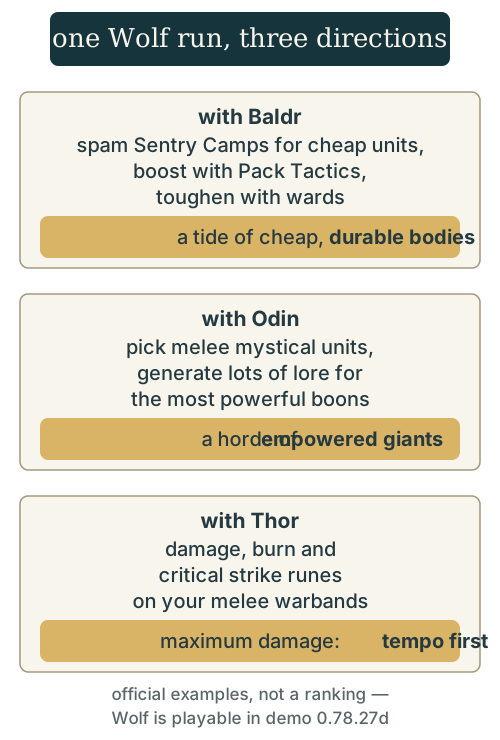
The developers’ earlier October overview demonstrates three directions for a Wolf run: cheap Sentry Camp units boosted by Pack Tactics and toughened by Baldr’s wards; Odin’s favor with melee mystical units fed by lots of lore; or Thor’s damage, burn and critical strike runes empowering melee warbands for tempo.
Wolf and Egil are playable in demo 0.78.27d, released October 19. These remain the developers’ October overview examples of how a clan, a god and structures combine, not tested strongest builds or step-by-step purchase orders. The update does not establish which direction is strongest.
Updated
How a build forms
In the developers’ words, a build comes from combining the power of your clan, the blessings of the gods, and the structures you place. Wolf’s half is fixed — raw melee power, with combat victories granting kröwns (see the Wolf guide) — so the interesting question is which god’s cards you spend lore on. That is exactly the variable these three examples change.
With Baldr: a tide of cheap, durable bodies
The first direction floods the board: spam Sentry Camps for cheap units, boost their attack power with the Pack Tactics skill, and toughen them with Baldr’s protective wards — in the developers’ summary, a tide of cheap, durable bodies. Baldr’s theme is making an army a lot tougher to kill, and here it is what turns the cheap tide durable.
With Odin: a horde of empowered giants
The second direction concentrates power: seek Odin’s favor, pick melee mystical units, and generate lots of lore to buy the most powerful boons for them — quashing foes with what the developers call a horde of empowered giants. Odin improves knowledge structures and mystical units, so this direction rewards a settlement built to generate that lore.
With Thor: maximum damage, tempo first
The third direction weaponizes the early fight: use Thor’s damage, burn and critical strike runes to further enhance your melee warbands for maximum damage output — favoring tempo over development. Where the Baldr direction leans on durability and the Odin direction on empowered units, the Thor direction spends on damage now rather than development for later.
On this page
Using these directions
EA check, October 27: Sentry Camp now has 0.5 Action Speed; Jotunn Camp has 0 Stun and 12/24/36 Damage. Check the three gods assigned to this run before selecting a direction. Current balance changes.
Treat the three directions as lenses, not scripts. The Baldr example says numbers plus durability is a plan; the Odin example says lore funneled into mystical units is a plan; the Thor example says early damage runes are a plan. Which lens fits depends on your map, the cards the fate phase offers and the ghosts you meet — and the same combination logic applies to Stag and Raven, whose economies point at different gods again.
Two neighbouring systems decide how far any of these go: favor grows as you keep picking a god’s cards, and a card’s scope decides whether it lifts one warband or the whole settlement.
Player check
Pick the direction that matches what you want from a Wolf run — then read the current card and structure descriptions and watch whether your layout, units and cards are actually serving it.
Sources: Developers’ October gameplay overview (the build formula and the three Wolf directions, 3:42–4:32) and Clan of the Wolf Demo Update (October 19 arrival).