
Gods & fate cards
Runes and blessings: one target or the whole settlement
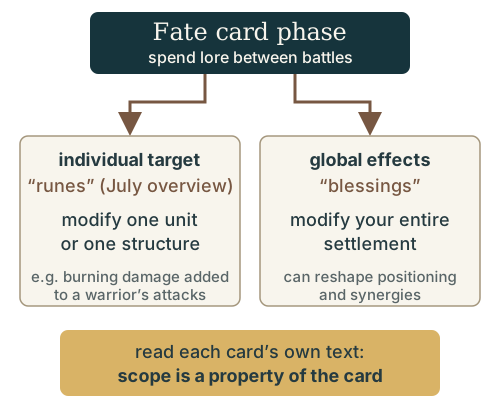
In the developers’ July overview, fate cards come in two scopes: runes modify an individual unit or structure, while blessings have global effects that modify your entire settlement and can completely change how you think about positioning and synergies.
“Runes” and “blessings” are the July overview’s terms; the official October demo imagery shows further card labels, so treat this as the scope distinction — not an exhaustive taxonomy of card types. Scope is a property of each card: read the card’s own text in the current build.
Runes: one target, done well
A rune strengthens one piece of your plan. The July overview’s examples: your warriors add burning damage to their attacks, or your axe throwers gain more damage each time they attack in battle. So when a rune appears, the useful question is which of your units or structures would benefit most from that specific effect.
On this page
Blessings: the whole settlement
A blessing changes the rules your settlement plays by. Because the effect is global, its value depends on how many of your units or structures it touches and how your layout serves it — which is why the developers say blessings can completely change how you think about positioning and synergies.
The official demo image’s example card Sentinels shows the shape of the idea: a blessing that grants your warband units armor for each adjacent tower — a global effect whose real value is set by your layout. That is a published example card, not a tested current value, but the lesson is structural: a blessing can turn building placement into card synergy. See building placement for the layout half of that equation.
Reading a card’s scope
- Find the recipient. Does the card name one unit or structure, a category such as warbands, or your entire settlement?
- Match it to your board. For an individual-target card, check which unit or structure benefits most from that effect; for a global card, count how many of yours it touches and whether your layout serves the condition.
- Keep scope separate from favor. Picking a god’s cards can also grow that god’s favor — a different effect with its own reach. Fate cards and favor walks through the difference.
Player check
Before spending lore on a card, say out loud what it modifies — one piece or the whole board — then check which of your units, structures or layout it would actually touch.
Sources: Developers’ gameplay mechanics overview (runes and blessings, 1:49–2:19) and the official demo content image from the September 30 announcement (the Sentinels example card).